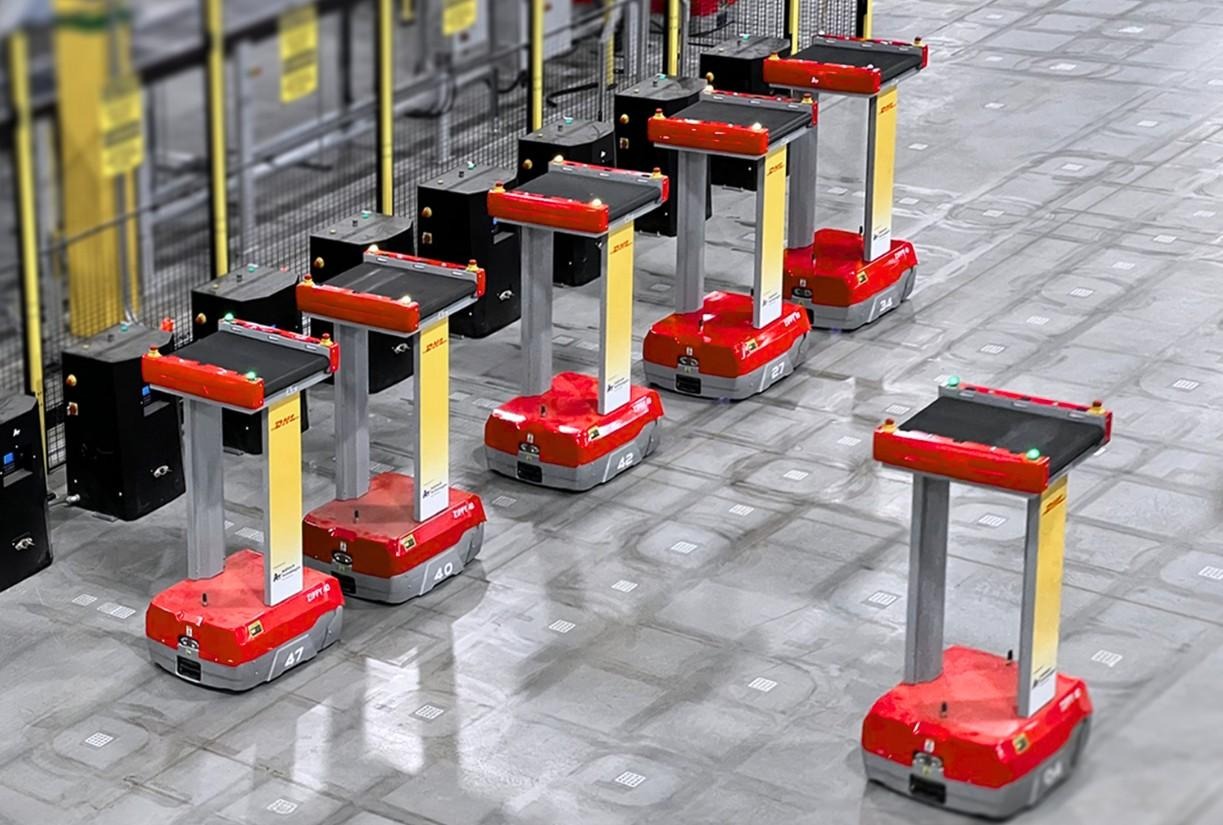
Rising inbound shipment volumes in US warehouses are creating significant pressure on dock operations, staging areas, and putaway processes. The majority of warehousing facilities are having difficulties handling the increased volume without building additional capacity, which may be expensive and time-consuming.
Under these conditions, warehouse robots are proving themselves to be an effective way of accelerating inbound logistics and utilising space more effectively. Warehouse robots minimise reliance on manual movement by enhancing coordination between the receiving and storage areas, enabling the USA warehouses to increase their productivity without constructing additional buildings or docks. There is now more emphasis on optimising operations within current facilities, particularly in high-demand US distribution networks.
Contents
- 1 Why Are Warehouse Robots Becoming Essential For Speeding Up Receiving And Unloading Operations?
- 2 What Role Do Warehouse Robots Play In Improving Putaway Speed And Inventory Accuracy?
- 3 How Do Warehouse Robots Reduce Congestion And Bottlenecks In Inbound Dock Operations?
- 4 How Do Warehouse Robots Enable Better Utilisation Of Limited Dock And Staging Space?
- 5 How Does Addverb Support Inbound Logistics Through Integrated Material Movement Systems?
- 6 Conclusion
Why Are Warehouse Robots Becoming Essential For Speeding Up Receiving And Unloading Operations?
Receiving and unloading procedures within warehouse settings in the USA are frequently hindered by manual procedures and a lack of coordination at the dockside. In times of increased inbound activity, this results in inefficiencies and congestion. The use of warehouse robots addresses these shortcomings by facilitating movement from the dock straight into staging/processing.
- Automated transport of pallets and cartons from receiving docks to staging zones
- Reduced dependency on forklifts and manual unloading during high inbound volume in the USA warehouses
- Continuous movement of goods that prevents blocking at the dock entry points
- Faster transition from unloading to processing without manual interruptions
This enhances the speed and efficiency of inbound operations, particularly in busy warehouses where turnaround time is imperative for success.
What Role Do Warehouse Robots Play In Improving Putaway Speed And Inventory Accuracy?
Once unloaded, the next step in warehouses involves the rapid and accurate placement of goods in their storage areas. Any problem that occurs at the put-away phase will result in slower processes and possibly inaccurate inventories. However, warehouse robots can enhance this process through better and faster placement of goods in the storage area.
- Automated routing helps move goods directly from receiving to assigned storage locations in the USA facilities
- Better coordination between inbound arrivals and available storage capacity improves efficiency
- Reduced human intervention minimises placement errors during putaway
- Faster execution supports higher inventory turnover in high-demand US operations
As a result, goods will be moved quickly and in the right place. This helps increase the reliability of the inventory.
How Do Warehouse Robots Reduce Congestion And Bottlenecks In Inbound Dock Operations?
The inbound docks in US-based warehouses are often known to be congested, as there is an accumulation of products which is faster than the processing rate. It results in inefficiency in operations and the usage of labour and space. Warehouse robots, such as autonomous mobile robots, help in overcoming this challenge by guaranteeing a constant flow of materials out of the dock area.
- Continuous movement prevents the accumulation of goods at receiving docks in the USA warehouses
- Balanced flow between unloading, sorting, and staging reduces operational delays
- Reduced manual handoffs help maintain a steady inbound processing speed
- Improved dock turnaround time increases overall inbound handling capacity
The constant movement of goods allows the warehouses to avoid congestion, which normally slows down inbound operations.
How Do Warehouse Robots Enable Better Utilisation Of Limited Dock And Staging Space?
Many US warehouses operate under fixed infrastructure constraints, where there may be no scope for increasing the docking or staging area. This is where the need arises to optimise the available space. Warehouse robots help here by ensuring efficient movement of products in a constrained space.
- Efficient use of existing layouts through automated internal transport flows in the USA facilities
- Continuous movement reduces idle accumulation at staging and dock areas
- Better coordination between receiving, sorting, and storage zones improves space usage
- Reduced manual stacking helps maintain clearer operational areas
This helps warehouses in the USA to process more incoming shipments without requiring any physical expansion.
How Does Addverb Support Inbound Logistics Through Integrated Material Movement Systems?
Addverb offers end-to-end material handling and automation solutions to optimise inbound logistics operations at US-based warehouse facilities. This includes conveyors, sortation, and AMR solutions to enable the seamless flow of materials from the receiving point to storage.
The company’s software layer, which includes the Warehouse Management System (WMS), enables effective coordination of inbound workflows, visibility into inventory, and control of warehouse operations. Thus, despite changes in demand, incoming processes will be systematic and responsive.
Addverb’s automation ecosystem connects material handling systems with warehouse software for the purpose of enhancing efficiency, reducing manual handling, and facilitating scalable inbound logistics operations in the USA.
Conclusion
In the USA, warehouse robots are revolutionising inbound logistics through increased speed in receiving, higher efficiency in the putaway process, and a lack of operational congestion without requiring infrastructure expansion. The optimisation of the existing warehouse space by robots makes them crucial.
They contribute to improved material flow and coordination, which helps the facilities to enhance their productivity and responsiveness across inbound activities. Addverb’s automation solutions assist in such a transformation by enabling scalable, robotics-driven inbound logistics optimisation aligned with efficiency goals in modern US supply chains.
